> For the complete documentation index, see [llms.txt](https://docs.powermonitor.com.br/llms.txt). Markdown versions of documentation pages are available by appending `.md` to page URLs; this page is available as [Markdown](https://docs.powermonitor.com.br/en/principais-funcionalidades/qualidade-de-dados.md).
# Data Quality
Power Monitor Data Quality: Environment X-Ray with a 0 to 100 score, lineage and dictionary, best practice scores for models and reports, Copilot readiness and credentials exposed in the models' code.
Monitoring whether the refresh ran is the basics. The next question is harder: **are the models and reports in my environment any good?** Are they well built, documented, ready for Copilot, free of passwords written in the code? And if I change this table at the source, what breaks?
The **Data Quality** module looks **inside** your semantic models and reports and answers this for the whole environment, without you opening a single PBIX file.
## Environment X-Ray: your organization's health score
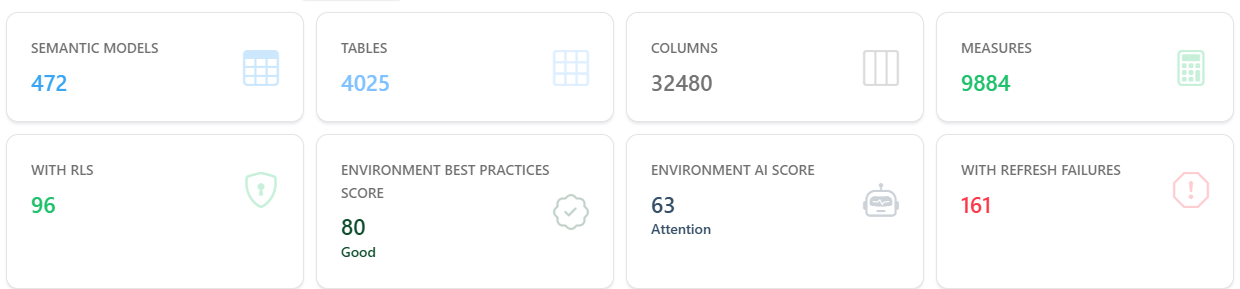
A score from **0 to 100** and the list of problems by severity (critical, high, medium and low) across six areas: data refresh, infrastructure, security and sharing, model quality, cost and licenses, and operations. Each finding comes with examples and a **direct link to the screen where you fix it**. The **Trend** card shows whether the environment improved or got worse since the last analysis.
Environment X-Ray: where to start
It is the perfect starting point for your governance meeting: what to fix first, why and where.
## Model and report best practices
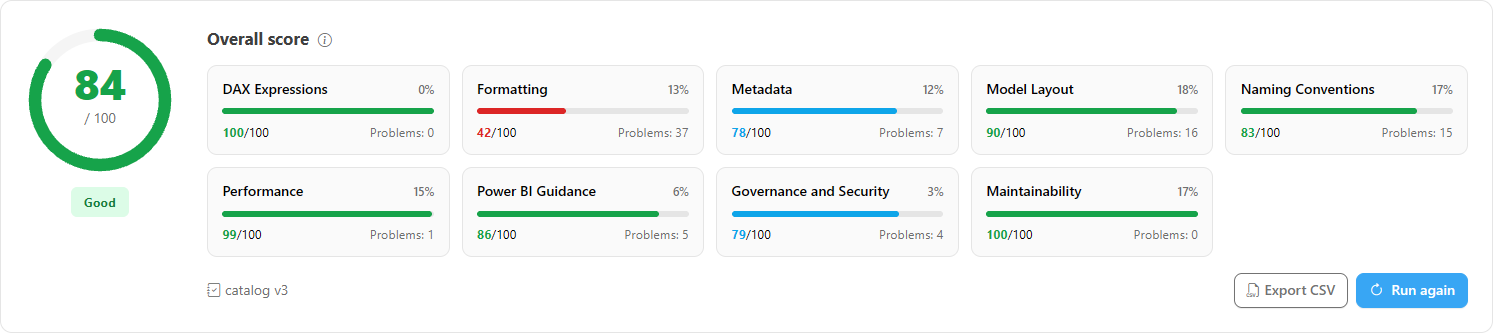
* **Best Practices Score** for models: 55 rules (Best Practice Analyzer, Microsoft guidelines and Power Monitor heuristics), with each model's score and what to fix.
* **Report Best Practices Score:** 61 rules covering page design, data binding, governance, lifecycle and accessibility.
* **AI Score:** how ready each model is for **Copilot** and natural language questions, such as descriptions, a date table and clear names.
Best Practices Score for models
## Lineage and change impact
* **Data Lineage:** where a model's data comes from and who consumes it: sources, gateways, reports, apps and composite models, including Fabric items such as notebooks, pipelines and Copy Jobs.
* **Data Dictionary:** start from a physical object (server, database, table or column) and discover every model and report that uses it. Before touching the source, you know what will break.
## Security inside the code
**Data Exposure** looks for **passwords, tokens and keys written directly in the Power Query** of your models and other leak risks. It is the kind of problem no Microsoft dashboard shows and that a security audit will find.
## Inventory for those who need the details
* **Environment Inventory:** one row per semantic model, with dozens of structure, health, usage and score metrics, ready to export.
* **Workspace X-Ray:** how many artifacts of each type exist in each workspace.
{% hint style="success" %}
All analyses work on the metadata Power Monitor has already collected. Nothing connects to your data in real time and nothing is changed in Power BI or Fabric.
{% endhint %}
## Why it matters
* **Measurable governance:** a score leadership understands and a prioritized list of actions.
* **Changes without surprises:** the impact of altering a source is clear before the change.
* **AI-ready:** well-documented models give better answers in Copilot.
* **Lower leak risk:** credentials in code are found before they become an incident.
## Related pages
* [Data Quality](/en/power-monitor/qualidade-de-dados.md): every screen in the module
* [Environment X-Ray](/en/power-monitor/qualidade-de-dados/raio-x-do-ambiente.md)
* [Performance Analysis](/en/principais-funcionalidades/analise-de-performance.md)
---
# Agent Instructions
This documentation is published with GitBook. GitBook is the documentation platform designed so that both humans and AI agents can read, navigate, and reason over technical content effectively. Learn more at gitbook.com.
## Querying This Documentation
If you need additional information that is not directly available in this page, you can query the documentation by asking a question.
Perform an HTTP GET request on the following URL with the `ask` and `goal` query parameters:
```
GET https://docs.powermonitor.com.br/en/principais-funcionalidades/qualidade-de-dados.md?ask=&goal=
```
`ask` is the immediate question: it should be specific, self-contained, and written in natural language.
`goal` is what the user is ultimately trying to achieve, the reason they need the answer. Sharing it helps GitBook give you a better, more relevant answer. A goal is most helpful when it describes the outcome the user wants rather than restating the question. For example, with `ask=how do I create an API token`, a goal like `automate deployments from our CI pipeline` lets GitBook tailor the answer to that use case.
The response will contain a direct answer to the question and relevant excerpts and sources from the documentation.
Use this mechanism when the answer is not explicitly present in the current page, you need clarification or additional context, or you want to retrieve related documentation sections.